Παρασκευή, 16 Σεπτεμβρίου 2022
Δελτίο Τύπου
Ομιλία του Υπουργού Οικονομικών κ. Χρήστου Σταϊκούρα στην Adam Smith Business School του Πανεπιστημίου της Γλασκώβης, με θέμα: «Σχεδιάζοντας και υλοποιώντας οικονομική πολιτική σε εποχές προκλήσεων: Ελλάδα, 2019-2022»
Τους βασικούς άξονες της οικονομικής πολιτικής που σχεδίασε και υλοποιεί η Ελληνική Κυβέρνηση την τελευταία τριετία, επιτυγχάνοντας – παρά τις πρωτόγνωρες, εξωγενείς δυσκολίες – πολύ θετικά αποτελέσματα, ανέλυσε χθες ο Υπουργός Οικονομικών κ. Χρήστος Σταϊκούρας, σε ομιλία του στην Adam Smith Business School του Πανεπιστημίου της Γλασκώβης.
Ο κ. Σταϊκούρας, αφού εξέφρασε τα θερμά συλλυπητήριά του για τον θάνατο της Βασίλισσας Ελισάβετ Β΄, ανέφερε ότι η θητεία του ως Υπουργού Οικονομικών υπήρξε εξαρχής γεμάτη προκλήσεις.
Όπως εξήγησε, τον Ιούλιο του 2019, η Κυβέρνηση της Νέας Δημοκρατίας, αμέσως μόλις ανέλαβε καθήκοντα, έθεσε σε εφαρμογή ένα ολοκληρωμένο, συνεκτικό σχέδιο, με στόχο την επίτευξη υψηλής, διατηρήσιμης και χωρίς αποκλεισμούς ανάπτυξης. Στο πλαίσιο αυτό, υλοποίησε άμεσα κομβικές μεταρρυθμίσεις και έλαβε φιλο-αναπτυξιακές νομοθετικές πρωτοβουλίες, που, μέσα σε μόλις τρεις μήνες, διαμόρφωσαν ένα ιδιαίτερα θετικό οικονομικό και επενδυτικό κλίμα.
Ωστόσο, στις αρχές του 2020, η πανδημία του κορονοϊού αποτέλεσε για την Ελλάδα, όπως και για όλες τις χώρες, ένα ισχυρό σοκ, που επέβαλε τη λήψη μέτρων για την προστασία του εισοδήματος των πολιτών και τη διαφύλαξη του παραγωγικού ιστού της οικονομίας, διασφαλίζοντας παράλληλα τη δημοσιονομική αξιοπιστία της εφαρμοζόμενης πολιτικής και αξιοποιώντας τον μέγιστο βαθμό συντονισμού με τους εταίρους μας στην ευρωζώνη και την Ε.Ε.
Στο πλαίσιο αυτό, ο Υπουργός Οικονομικών δήλωσε ότι ελήφθη ένα ευρύ πλέγμα άμεσων, προσωρινών και στοχευμένων μέτρων στήριξης, συνολικού ύψους 43 δισ. ευρώ, ενώ ταυτόχρονα συνεχίστηκε το μεταρρυθμιστικό έργο της Κυβέρνησης. Έτσι, όπως τόνισε, η χώρα μας κατάφερε να καταγράψει ανάπτυξη τύπου “V” το 2021, οι επενδύσεις και οι εξαγωγές ενισχύθηκαν, το πραγματικό διαθέσιμο εισόδημα των νοικοκυριών στηρίχθηκε, το οικονομικό κλίμα βελτιώθηκε, τα μη εξυπηρετούμενα δάνεια μειώθηκαν, οι τραπεζικές καταθέσεις αυξήθηκαν δραστικά και η ανεργία συρρικνώθηκε. «Όλα αυτά τα επιτεύγματα οφείλονται και βασίζονται στην εφαρμογή μιας συνετής, συνεκτικής, φιλο-μεταρρυθμιστικής, φιλο-αναπτυξιακής και διορατικής οικονομικής πολιτικής», υπογράμμισε.
Υπό τις παραπάνω συνθήκες, «η “μεγάλη εικόνα” της ελληνικής οικονομίας το 2021 ήταν θετική και οι προοπτικές της ακόμα πιο θετικές», είπε ο κ. Σταϊκούρας. Ωστόσο, προέκυψε μια νέα εξωγενής πρόκληση: η εισβολή της Ρωσίας στην Ουκρανία, με τις συνακόλουθες επιπτώσεις της στο ενεργειακό πεδίο και στον πληθωρισμό.
«Σε εθνικό επίπεδο, προσπαθούμε να περιορίσουμε τον αντίκτυπο του τεράστιου ενεργειακού σοκ σε νοικοκυριά και επιχειρήσεις, μέσω επιδοτήσεων στους λογαριασμούς ηλεκτρικού ρεύματος, ειδικά για τα πιο ευάλωτα τμήματα του πληθυσμού», ανέφερε ο Υπουργός Οικονομικών και συμπλήρωσε ότι, για τον σκοπό αυτό, η Κυβέρνηση δημιούργησε έναν μηχανισμό αξιοποίησης των υπερκερδών των ενεργειακών εταιρειών, αξιοποίησε πόρους του Ταμείου Ενεργειακής Μετάβασης και πόρους του Κρατικού Προϋπολογισμού. «Η χρηματοδότηση από τον Κρατικό Προϋπολογισμό ήταν μέχρι τώρα εφικτή επειδή, το 2022, είχαμε υψηλότερα του αναμενομένου δημόσια έσοδα, κυρίως χάρη στη μεγαλύτερη, σε σχέση με τις εκτιμήσεις, ανάπτυξη. Αυτό μας επιτρέπει να παρέχουμε αυτές τις ενισχύσεις, χωρίς να θέτουμε σε κίνδυνο τους δημοσιονομικούς στόχους μας. Και κατ’ αυτόν τον τρόπο θα κινηθούμε στο μέλλον. Η δημοσιονομική στήριξη θα πηγαίνει χέρι-χέρι με τη δημοσιονομική υπευθυνότητα. Θα προσφέρεται στον μέγιστο δυνατό βαθμό, χωρίς να διακυβεύεται η βιωσιμότητα του δημοσίου χρέους μας», επισήμανε.
Ο κ. Σταϊκούρας έκανε ειδική μνεία στην εντατική υλοποίηση του Εθνικού Σχεδίου Ανάκαμψης και Ανθεκτικότητας, στην ενίσχυση του τραπεζικού συστήματος, στη διατήρηση της ισχυρής μεταρρυθμιστικής δυναμικής και στην εφαρμογή μιας πολύ αποτελεσματικής στρατηγικής διαχείρισης του δημοσίου χρέους.
Στο σημείο αυτό, ανέπτυξε τα χαρακτηριστικά που πιστοποιούν τη βιωσιμότητα του δημοσίου χρέους και υπενθύμισε: «Όπως έχουμε ανακοινώσει, στο τέλος του έτους, θα προχωρήσουμε στην πρόωρη αποπληρωμή μέρους των δανείων που συνάφθηκαν στο πλαίσιο του 1ου προγράμματος προσαρμογής».
Ο Υπουργός Οικονομικών υπογράμμισε ότι «με την παραπάνω πολιτική, η ελληνική οικονομία κατάφερε να επιδείξει αξιοθαύμαστη ανθεκτικότητα το 2022», με σχεδόν διπλάσιο ρυθμό ανάπτυξης από τον μέσο όρο της ευρωζώνης το 1ο εξάμηνο του έτους, περαιτέρω μείωση της ανεργίας και του δημοσίου χρέους και σταδιακή αύξηση της βιώσιμης παροχής πιστώσεων από το τραπεζικό σύστημα. «Εν ολίγοις, όπως το 2020 και το 2021, η Ελλάδα συνεχίζει να αποτελεί την έκπληξη μεταξύ των οικονομιών της Ε.Ε. το 2022», τόνισε, αλλά πρόσθεσε: Παρά τη σημαντική πρόοδο που έχουμε πετύχει, δεν μπορούμε, όμως, να υποβαθμίζουμε τους σημαντικούς κινδύνους», εξαιτίας του υψηλού πληθωρισμού, και, ιδίως, λόγω των υψηλών τιμών στην αγορά ενέργειας.
«Πιστεύουμε ότι καμία χώρα δεν μπορεί να αντιμετωπίσει επιτυχώς αυτές τις προκλήσεις μόνη της… Χρειάζεται να συντονιστούμε όσο περισσότερο είναι εφικτό, όχι μόνο στην οικονομική αλλά και στην ενεργειακή πολιτική», είπε ο κ. Σταϊκούρας και αναφέρθηκε στις σχετικές προτάσεις που έχει καταθέσει η Ελληνική Κυβέρνηση στην Ευρωπαϊκή Επιτροπή.
Συνοψίζοντας, ο Υπουργός Οικονομικών επισήμανε ότι «η εμπιστοσύνη και η αξιοπιστία αποτελούν τον ακρογωνιαίο λίθο της αποτελεσματικής οικονομικής πολιτικής, και αυτές κατακτώνται με τη συνέπεια λόγων και έργων. Τα τελευταία τρία χρόνια, ακολουθούμε αυτή την προσέγγιση, επιδεικνύοντας, σύμφωνα με όλες τις αξιολογήσεις, πολύ θετικά αποτελέσματα. Ξέρουμε πού βρισκόμαστε, ξέρουμε πού θέλουμε να πάμε και ξέρουμε πώς θέλουμε να πάμε εκεί! Είμαστε αποφασισμένοι να συνεχίσουμε σε αυτόν τον δρόμο, προς όφελος των πολιτών και των μελλοντικών γενεών».
Ακολουθεί το πλήρες κείμενο της ομιλίας του Υπουργού Οικονομικών κ. Χρήστου Σταϊκούρα, στα αγγλικά:
I would like to offer my sincerest condolences for the death of Her Majesty Queen Elizabeth the Second.
A unique and much-admired leader in so many different ways, Her Late Majesty was an enduring source of inspiration worldwide, well beyond the United Kingdom and the Commonwealth, for her outstanding sense of duty, devotion and commitment to the service of her people, as well as her ability to combine respect with the need to adapt to a fast-changing world.
At this time of national mourning, and I believe that I speak on behalf of all fellow Greeks, our thoughts are with the Royal Family and our British friends.
May her Majesty rest in peace.
Eternal Memory!
Dear All,
Ιt is honour and pleasure to be a guest of the Adam Smith Business School, at the University of Glasgow, to share with you thoughts and experiences regarding the design and implementation of economic policy in challenging times.
I have now completed 3 years of service in the post of Minister of Finance of the Hellenic Republic.
And in describing the last 3 years as challenging, I have to candidly admit that I adopt the globally much-admired British art of understatement.
Back in July 2019, economic growth was very low, the lowest among EU member-states over the previous parliamentary period.
Despite a modest fall in 2017 and 2018, unemployment, at 18%, was still, by far, the highest among EU member-states, particularly among women and the youth.
The living standards of our citizens, measured in terms of per capita income, continued diverging from the EU average, while public and private debt were still increasing.
In the area of finance, our banking system had an excessive ratio of non-performing loans, close to 40%, seriously putting obstacles on healthy credit expansion.
This, along with low rankings of business environment, mainly caused by excessive red-tape and significant labour skills shortages, significantly curtailed investment.
As a result of these serious macroeconomic imbalances, and despite the end of the formal financial adjustment programmes, Greece was placed in the Enhanced Surveillance framework, implemented in the context of the euro zone when a member-state presents serious macroeconomic imbalances, threatening the stability of the union.
In short, when we took office, 3 years ago, our economy was in a pretty bad state.
It lacked dynamism and, more than anything, real prospects.
That was particularly hard to our young people, many of which felt that they had little chance of success and prosperity, unless they emigrated abroad.
This situation was clearly unacceptable to us.
We had to reverse it.
For that, we needed a good plan.
And when we went into government, we had one.
It had 3 major inputs; namely, our own experience, international best practices and expert advice.
Despite its elaborate nature, the intellectual basis of our economic plan was, and continues to be, fundamentally simple.
You can think of it in terms of a simple production function.
Our diagnosis was that our growth was low because we had no sufficient capital stock, hence we needed to increase investment; we had not sufficient labour input, hence we needed more employment; and, finally, we had limited factor efficiency, hence we needed higher productivity.
To achieve these things, we needed to improve expectations, hence we needed to be fiscally credible and, also, send good signals by front-loading reforms.
We also needed to unlock financing of the real economy, by sorting-out our banking sector.
Last, but not least, to execute the plan, we had to put in place the right personnel.
We entrusted many government positions, both in the cabinet as well as in other key vacancies, to technocrats with expertise on the subjects they work on.
The best talent, to the right place, for the best service, to the Greek people.
So, and to return to confectionary, on our behalf we laid our stall and put our pudding on display.
But would the pundits like it?
And yes, they did.
First, the voters endorsed our manifesto and gave us a large parliamentary majority to implement it.
And markets also gave us thumps-up.
After the elections, we hit the ground running.
We had already prepared some key reform, growth-friendly legislation, which we passed in the first 3 months of being in office.
Among others, during our first weeks in office:
- We introduced a host of measures gradually reducing business, labour and property taxation, in a step-wise fashion as not to risk fiscal targets.
- We passed an omnibus law simplifying investment licencing and generally facilitating investments.
- We introduced legislation reducing excessive regulation of the labour market, to the benefit of both employers and employees.
- We started working on an Asset Protection Scheme, which eventually resulted into a dramatic fall of non-performing loans.
Three months into our office, all “stakeholders”, including ourselves, were in high spirits.
Despite increasing external headwinds, at the time associated with the intensifying trade war between the United States and China and uncertainty as to how Brexit would play out, the omens were good.
And I say omens because, you see, a national economy does not turn round immediately.
There are stages in achieving economic progress.
Roughly speaking, these stages are based on 4 steps.
First, you announce good policies, which we had done.
Second, markets communicate their confidence, by moving financial variables, such as government bond yields, to the right direction.
Indeed, at the end of 2019, that was the case: economic sentiment indicators had sky-rocketed, to their highest value for more than decade.
Third, as good policies are gradually implemented, higher frequency macro variables, such as industrial production, international competitiveness and investment spending, start improving.
And, at the last stage, growth increases and unemployment falls.
A rule of thumb is that the time-space between the 1st and 4th stage is in the order of 18 to 24 months.
If only we had such a luxury.
Because in early 2020, the shock of the century, the covid-19 pandemic, struck!
Ladies and Gentlemen,
Like all countries, Greece did not anticipate, and therefore was not prepared for an emergency, such as the pandemic.
The situation was so fast-moving and unpredictable, that nobody could make any meaningful forecast.
I remember that, in one of our very first closed internal meetings before we went in lockdown, back in January 2020, we had estimates that, in the worst-case scenario, covid would cause a recession of 2 percent and we would need measures to support firms and households in the order of 4 billion euros.
That is approximately equal to 2% of our GDP.
At Eurogroup and ECOFIN meetings, I was getting similar projections – some even questioned that there will be a recession at all.
However, as Covid started spreading rapidly in Europe in February 2020, the scale of the medical emergency started becoming clearer.
It became apparent a short-run trade-off between public health and economic outcomes.
On the one hand, keeping economic and social life risked putting excessive pressure on our health system and serious loss of life.
On the other, going into a lockdown risked very serious economic turbulences.
All European countries were facing the same dilemma.
My team, in the Ministry of Finance, went into crash courses on health economics, reading papers on the economics of Spanish flu, the economics of pandemics and a fast-growing early literature on Covid itself.
My colleagues, at the General Accounting Office, were spending sleepless nights, working on various macro- and fiscal scenarios.
Eventually, on March, 23rd, and with case numbers still very low, we decided that our first priority was to protect public health and became one of the first European countries, after Italy, to go into a full lockdown.
This saved lives and gave us valuable time to manage the pandemic, until vaccines arrived in late 2020.
However, as it turned out eventually, we went into a recession of 9 percent in 2020, and the final cost of Covid-related support measures was 43 billion euros, that is 23.5% of our GDP.
Thus, for Ministers of Finance, the pandemic and the lockdown produced an unprecedented triple shock:
First, a temporary, but very strong supply shock.
As many people could not go to their workplaces, the lockdown reduced production of goods and services and, by extension, incomes of employers and employees.
Second, a very strong demand shock.
In addition to incomes, the lockdown reduced consumption options.
Even if consumers retained purchasing power and wished to consume, the lockdown curtailed their opportunities to do so, particularly when it came to contact-intensive services.
You can image the problems this caused to an economy, heavily relying on tourism.
Third, a strong shock of uncertainty, amplifying the previous two.
As nobody really knew how things would play out, investors started postponing investment decisions and consumers delayed purchases, economic sentiment indicators plummeted and precautionary savings were built up, along with forced ones.
The combination of the above is very challenging for every Finance Minister, especially one who has to deal with a heavy legacy of a very recent big crisis, as it was the case in my country.
So, how did we read the situation and how did we respond?
First, it was pretty obvious to us that we should not let demand collapse.
We had to protect labour incomes.
That was necessary both to avoid serious social upheaval, but also for stabilisation purposes.
Going into the pandemic with a closing but still very significant negative output gap, we had to mitigate, as much as possible, the effect of the pandemic on economic activity.
Second, it was paramount to protect the production fabric of our economy.
We had to avoid scarring.
We needed to make sure that our viable firms had enough liquidity available not to shed labour, not default on their loans and, ultimately, not go out of business.
Third, we had to re-assure sovereign bond markets that our policy was fiscally credible, maintaining the confidence regarding Greece’s medium-term debt sustainability.
Last but not least, we had to use maximum co-ordination with our eurozone and EU partners.
This co-ordination was necessary at 3 levels; among national fiscal policies, between national fiscal policies and the single monetary policy, and among individual member-states.
With these considerations in mind, we took actions consisting of timely, temporary and targeted support measures.
Among other measures:
- To protect labour income and support demand, we used income compensation schemes, we reduced labour taxes, property taxes and employees’ social insurance contributions, we temporarily increased some social welfare benefits, and also temporarily reduced VAT rates on selected commodities.
- To maintain liquidity and avoid scarring, we provided state-guaranteed loans to firms, backed by re-purposed EU Cohesion Funds, through our National Development Bank.
- To bypass bottlenecks in bank credit provision, we set-up a highly innovative, minimum-red-tape loans’ provision mechanism, providing liquidity directly from the State to firms, especially to SMEs, and we introduced an efficient scheme based upon the German kurzarbeit model.
- To maintain market credibility and re-assure markets about medium-term sustainability, we continued, with determination, our reform effort.
On the subject of reforms, I can literally speak for hours, as over the last three years we have passed more that 330 omnibus laws, incorporating long-overdue, growth-enhancing reforms.
To name a few but representative ones, starting with my Ministry:
- We have introduced the highly successful Hercules Asset Protection Scheme, which has been instrumental in reducing the NPL ratio from 40% in mid-2019 to 10% in 2022Q2.
- We have introduced new corporate governance rules.
- We have also introduced a state-of-the-art new insolvency framework, whose implementation will increase sustainable credit growth, capital value preservation in the event of bankruptcy, and strong incentives addressing moral hazard in the area of credit provision.
- We have also concluded a number of emblematic privatization projects.
Indeed, over the last three years, Greece has successfully completed important reforms in 6 key areas, namely fiscal and fiscal-structural policies, social welfare, financial stability, labour and product markets, privatizations, and public administration.
Furthermore, Greece completed important reforms in areas not covered by the Enhanced Surveillance framework, including, among others, digitalization and education.
Finally, Greece participated actively and contributed significantly to what turned-out to be a very successful management of the pandemic at the European Union level.
Here, let me briefly comment upon the highly successful handling of the pandemic crisis on behalf of the European Central Bank.
This provided appropriate support to demand from the monetary policy side, maintaining, at the same time, favourable financial conditions, allowing sovereigns comfortable margin, to finance the fiscal side of the stabilization effort.
As far as fiscal co-ordination is concerned, unlike the European Sovereign Debt Crisis, where the initial European handing of events was anything but successful, this time round Europe re-acted much more swiftly and effectively.
But make no mistake: that was not easy.
Yes, we did agree eventually, but in the best tradition of the EU way of doing things, there was a lot of negotiation at the table and behind the scenes, some “frank and direct” exchanges of opinions, and a few all-night negotiation rounds, thrown in for good measure.
I can vividly remember an ECOFIN meeting held by video-conference in April 2020.
We started at 5 pm Athens time, finished at 9.00 am next morning, without agreement reached.
But eventually, through compromises, we did agree.
In fact, we made history, as for the time, in response to the pandemic crisis, the EU member-states agreed to joint debt issue, for an amount up to 750 billion euros, to finance recovery in the context of the Next Generation EU programme.
Greece made a very significant contribution towards this historic development, as our Prime Minister was a pioneer among the 9 heads of state who proposed, on March 20th, the creation of a common debt instrument to address the economic fallout of the Covid pandemic.
Greece secured in grants and loans 30.5 billion euros, which represents approximately 16% of our pre-Covid GDP, the highest among euro-zone member-states.
The Next Generation EU programme has a very sound fundamental economic approach.
The main idea is to provide funds to support demand in the short- and medium-term, so that output is stabilized in its natural level, and also increase long-term production capacity, so that the EU, as a whole, keeps with other major economic powers at the world stage.
In line with the programme’s provisions, we submitted, to the European Commission, in April 2021, our National Recovery and Resilience Plan, called “Greece 2.0”.
In July 2021, our Plan was approved, with flying colours, by the ECOFIN Council.
It is a plan of fundamental economic and social transformation, which affects economic activity, but also technology, attitudes and institutions.
A transition that combines economic efficiency with social cohesion and justice, steering the Greek economy towards an extroverted, competitive, inclusive, green and digital growth model.
Returning to our subject, in 2020 and 2021 we faced the unprecedented, exogenous, symmetric shock, and we reacted to it in the way I described above.
What is the verdict on our crisis-management response?
I think it is fair to say that we did well.
Among others, in 2021:
- A “V-shape” recovery has been recorded.
- Investments and exports of goods and services were strengthened.
- The real disposable income of households was supported.
- The economic sentiment improved.
- Non-performing loans decreased and deposits increased, drastically.
- Unemployment has shrunk, significantly, and employment increased by double the level of inactivity reduction.
All these achievements are due to and based on the implementation of a prudent, coherent, reform-oriented, growth-friendly and insightful economic policy.
Consequently, the “big picture” of the Greek economy in 2021 was positive and its prospects even more positive.
As a result, the turn of the year found us in optimistic mood, as we thought we were exiting the woods.
But once again, that was not the case.
Because on February 2022, Russia invaded Ukraine.
Ladies and Gentlemen,
Back in Athens, my day started with an emergency meeting under the Prime Minister on the economic fallout of the War.
Later in the morning, I flew to Paris for an informal Eurogroup/ECOFIN meeting.
The mood among my colleagues was one of indignation and concern.
We were all in agreement that any macro projections we had been given, were already outdated, and we needed to return to scenarios-based forecasts.
Back home, Michael’s [Michael Arghyrou’s] team started adding energy economics to their armoury of newly acquired expertise.
We were back to full crisis management mode.
The Russian invasion has similarities with the pandemic shock, but also some important differences.
It is first and foremost a major negative supply shock, happening at a time that demand was strongly recovering.
As a result, although like Covid, it has strong output contractionary effects; unlike Covid, this is a highly inflationary shock.
From that point of view, in terms of designing economic policy, managing the economic fall-out of the war is an even more challenging exercise than responding to Covid.
This is because, in the case of Covid, it was pretty clear that both fiscal and monetary policy had to be expansive, as that would sustain firms and households, stabilise output and prices.
Now, the need to stabilise output arises again, but as the shock comes from the supply side, this objective is at cross-purposes with price stabilisation.
Thus, there are numerous policy objectives, but only limited policy instruments to meet them.
Furthermore, like Covid, the war in Ukraine is a major uncertainty shock.
Yet, it differs in this respect too.
The pandemic is a major medical emergency – hugely disruptive, but ultimately transitory.
You know that, at some stage, it will end; it will leave you with a legacy of higher debt, but it will not be there for ever.
Eventually you will have to mop up the economic mess and move on.
In economics jargon, it is a big but not persistent shock.
This is not the case with the Russian invasion.
The war creates long-term uncertainty, as it is an event of catalytic significance for European security and defence.
It has ushered a new geopolitical period, in which the need for European strategic autonomy in energy supply, critical supply chains and defence deterrence have greatly increased.
For us, Finance Ministers, this changes the policy framework under which we operate, as uncertainty regarding some key variables, such as security of energy and food provision, has increased permanently.
“Near-shoring” and “friend-shoring” are terms now trending among policy makers and the business community, and this comes with opportunities for my country.
So, how are we dealing in Greece with this second, exogenous major shock?
Some things are of course out of our control.
We cannot influence the military outcome on the battlefields of Ukraine.
We can also not affect global energy prices, nor of course can we intervene with the decisions of the European Central Bank, which is fully independent.
But we do aim to make maximum use of our policy degrees of freedom at the national and the European level.
Specifically:
At the national level, we try to smooth the impact of the huge energy shock on firms and households, by providing subsidies to energy bills, particularly for the most vulnerable parts of the population.
However, we must make sure that this policy does not compromise our fiscal targets and the dynamics of our public debt, which in 2021 returned to a fast-declining trajectory.
To that end, we have designed an innovative finance scheme, whereby we temporarily use the windfall revenues of electricity suppliers at marginal cost, below the clearing price determined at our energy exchange.
This scheme now serves as a model for other countries, considering the introduction of similar subsidy financing schemes.
We also use windfall profits from the Emission Trading Scheme (ETS), caused by the increase in the price of licences to finance energy-related subsidies.
And, yes, we also finance energy subsidies from the state budget.
This financing, however, has so far been possible because, in 2022, we have been having higher than expected public revenue, caused – mainly – by higher than anticipated growth.
This allows us to provide these subsidies, without risking our fiscal targets.
And this is how we will move in the future.
Our fiscal support will go hand in hand with fiscal responsibility.
It will be provided to the maximum possible extent, without compromising the sustainability of our public debt.
Second, we are stepping up the implementation of our Recovery and Resilience Plan.
This is now in the second year of its implementation.
It is in full swing, it is on track, and it is delivering increasing support of economic activity, both from the grants as well as from the loans’ component.
The latter is particularly attractive for firms investing in the green and digital transition, extroversion, economies of scale and innovation, as within an environment of fast-rising interest rates, it provides loans at very attractive cost of capital, subject to strict eligibility and market-based scrutiny.
Third, we continue strengthening our banking system, where the NPL ratio continues its de-escalation.
Fourth, we maintain our strong reform momentum, including privatisations.
This is particularly important for investors, credit-rating agencies and financial markets, as it confirms that the process of upgrading the supply side of the Greek economy is not slowed down.
Today, we started discussing in the Greek Parliament, the establishment of a Public Credit Bureau and of a Central Credit Registry.
Finally, we continue to implement a very efficient public debt management, allowing us to maintain reassuringly high cash reserves, and full access to international sovereign bond markets, at affordable cost of financing.
In relation to this, we have announced that, at the end of this year, we will make an early prepayment of part of the loans agreed in the context of our first adjustment programme.
This is a strong market signal, reassuring markets regarding the sustainability of our fiscal path.
Moreover, Greek public debt, as confirmed recently by IMF, ESM and the European Commission, is sustainable, because:
- it has a long weighted average maturity,
- most of it is held by the official sector, and
- it presents a significant fixed rate component.
Additionally, Greek debt presents low average annual gross financing needs, in the range of 10% of GDP for many years ahead.
The policy described above has put in place a platform for the Greek economy to show remarkable resilience in 2022.
During the first semester of the year, our economy grew by 7.5% y-on-y, significantly above initial estimates and almost double the average EU growth rate.
Unemployment continues its decline.
Public debt is on track for a second consecutive year of record decline, while our banking system is gradually increasing sustainable credit provision.
The improvement of our macro performance continues displaying important positive qualitative characteristics.
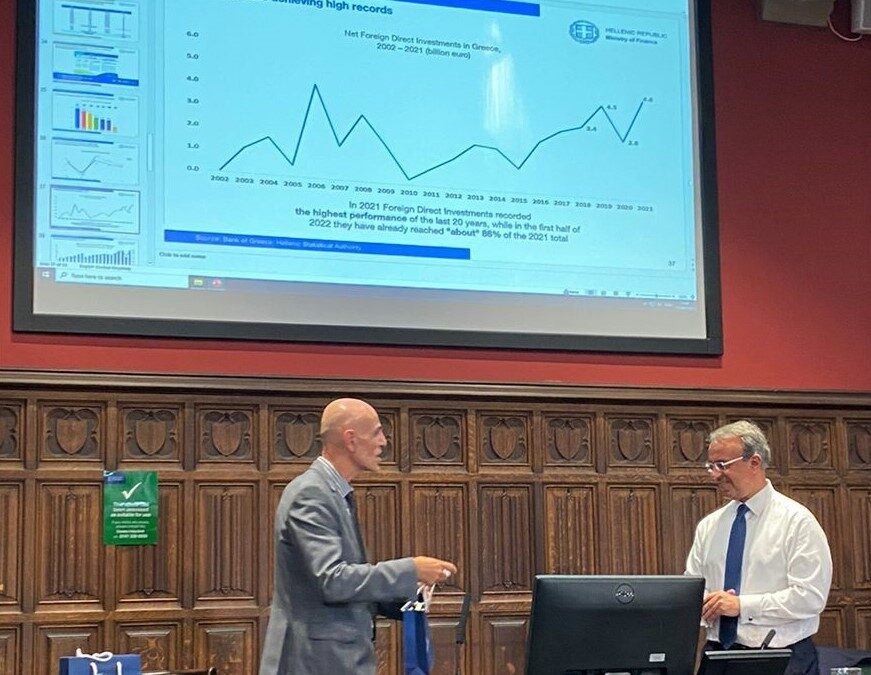
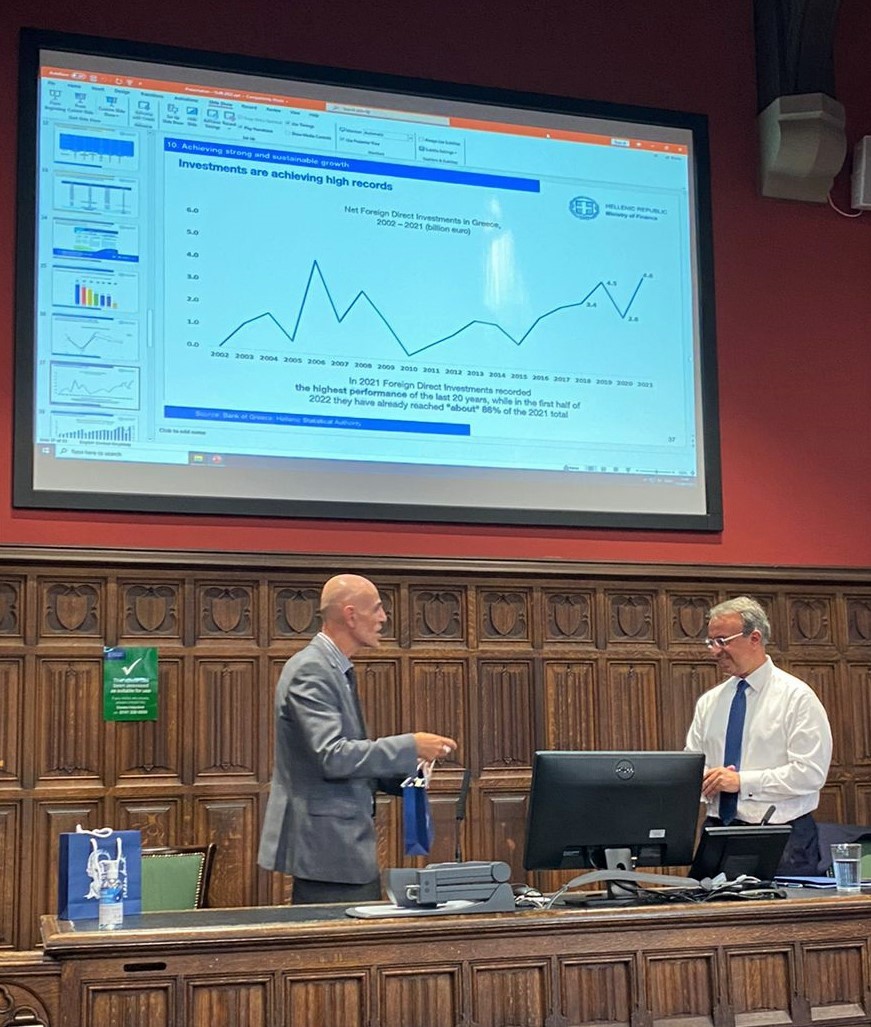
Exports, foreign direct investment and investment in R&D, continue registering new records.
Unemployment continues to decline more rapidly among women and the youth.
The share of higher value-added, high-tech products in Greek manufacturing production continues to exist.
Furthermore, Greece continues its rapid digitalisation progress, while renewable energy sources continue making inroads into our electricity production mix.
In short, as in 2020 and 2021, Greece continues to be the surprise package of the EU economy in 2022.
This is confirmed by continuous upgrades of the Greek sovereign and banks on behalf of major rating agencies, including 4 upgrades in 2022, following the war’s onset.
It is also confirmed by the decision of the European Commission, endorsed by the Eurogroup meeting of June 2022, to put an end to Enhanced Surveillance as from August 20th, 2022.
After more than ten years, Greece has returned to normal European surveillance.
As the United States Department of State has recently commented in its investment 2022 Climate Statements on Greece, “far from being the problem child of Europe or the international financial system, Greece is increasingly a source of solutions – not just in the fields of energy diplomacy and defence, but in high-tech innovation, healthcare, and green energy, improving prospects for solid economic growth and stability here [in Greece] and in the wider region.”
However, despite the important progress we have achieved, we cannot be complacent, and we cannot downplay important risks.
Inflation is hitting hard the disposal income of households and, if left unchecked, may derail the economic recovery not just of Greece, but the whole European continent.
Suring energy prices in particular, have very serious potential social repercussions.
We believe that no country can meet successfully this challenge on its own.
To counter this act of economic aggression, we believe that we need to co-ordinate as much as possible, not only in economic but also energy policy.
Greece has proposed to the European Commission three lines of action:
First, and as long as the emergency remains in place, the introduction of a ceiling in the European wholesale market for natural gas.
This will effectively counter the monopolistic power Russia exercises as a dominant supplier of natural gas to Europe, and will also reduce the present excessive price volatility, which causes very significant secondary effects.
Second, we have proposed to reform the European electricity market, in a way delinking electricity prices from prices of natural gas.
Third, we have proposed joint procurement and storage of natural gas.
Last but not least, we fully subscribe to the view that the surge in electricity prices should not delay the green transition; in fact, it should accelerate it.
This is because by moving to greener energy, not only we safeguard climate sustainability, but also we acquire strategic autonomy versus authoritarian regimes not sharing the principle values of European liberal democracy.
Ladies and Gentlemen,
I have tried to give you a flavour of the challenges we have faced in policy design and implementation during the challenging times we have been facing over the last three years.
I have gone in some detail to explain to you how we read the fast-changing situation, how we have been addressing it, and the rationale behind our actions.
If I were to summarise telegraphically the main ingredients of successful policy making, I would say that policy design and implementation must be based on expert analysis and data evidence, policy communication must be clear and transparent and, above all, policy-making must be credible.
Trust and credibility are ultimately the cornerstone of successful policy, and to obtain them the words of policy makers must be consistent with their deeds.
Over the last three years, we have been following this approach, delivering, by all accounts and assessments, very positive results.
We know where we are, we know where we want to go, and we know how we want to go!
We are determined to continue along this path, for the benefit of all our citizens and future generations, as well as the stability and prosperity of the European Union, and its friends and allies, to which the United Kingdom is second to none.
Thank you for your attention.
Δείτε σχετικές φωτογραφίες:



Κατεβάστε την Ομιλία του Υπουργού εδώ:
2022-09-16 ΔΤ_Ομιλία_ΥΠΟΙΚ_Glasgow_University